Telephony & Unified Communication System
Modern buildings and businesses in India need more than just “calling.” They need a single communication fabric that connects voice, video, messaging, mobility, meetings, and customer interactions—securely, reliably, and with clear control. Telephony & Unified Communication (UC) brings all these channels together so your teams, residents, visitors, vendors, and customers can reach the right person instantly—whether they’re at a desk, on a mobile app, in a control room, or at a remote site.

Why UC Systems are widely adopted in India?
At ACE Technologies, we design, deploy, and maintain UC solutions for Indian environments—from a small apartment setup to large campuses, IT parks, data centres, hospitals, factories, government offices, and multi-location enterprises.
Indian deployments often require:
- Multi-site connectivity (HQ + branches + warehouses + remote teams)
- High call volumes (customer care, admissions, helpdesks, security desks)
- Multilingual IVR and routing
- Scalability without replacing everything
- Cost control (VoIP/SIP trunks vs legacy lines where suitable)
- Business continuity (failover, backup links, power protection)
UC delivers measurable gains: faster response, fewer missed calls, better customer handling, and simplified management across sites.
Industries We Serve

Small Apartment / Duplex / Bungalow

Residential Complex / Gated Communities

Malls / Retail / Multiplexes

IT Parks / Corporate Buildings

Factories / Industries

Hospitals / Clinics

Government

Data Centres
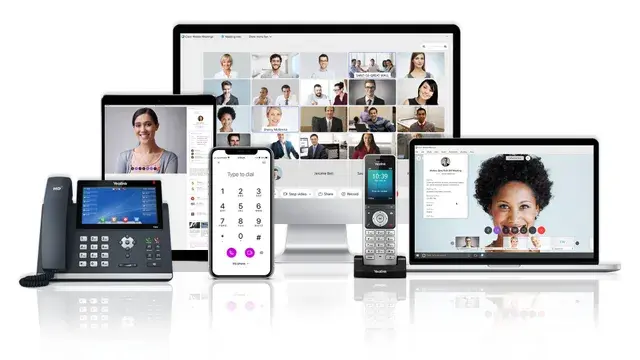
What is Telephony & Unified Communication?
A Unified Communication System integrates:
- Voice calling (IP Telephony / VoIP)
- Video calling & conferencing
- Chat / instant messaging & presence
- Unified messaging (voicemail-to-email, notifications)
- Mobility (softphone apps, work-from-anywhere extensions)
- Collaboration workflows (call escalation to meeting, shared contacts, click-to-call)
Unlike traditional PBX-only setups, UC is designed to run on your IP network and can be implemented as:
- On-premises IP PBX
- Cloud / hosted UC (UCaaS)
- Hybrid (best of both: on-prem control + cloud mobility/meetings)
Core Components of a Telephony & Unified Communication System
Call Control Platform (IP PBX / UC Server)
- Extension management, ring groups, time-based routing
- Multi-level IVR / auto-attendant
- Call queues, skill-based distribution, voicemail
SIP Trunks / PRI / Analog Lines & Voice Gateways
- SIP trunking (IP-based calling)
- PRI (where legacy integration is required)
- Analog lines (backup / lift / hotline / legacy devices)
Endpoints: IP Phones, Softphones, Video Phones & Conference Devices
- Desk IP phones for users/reception/security
- Wireless/DECT phones for mobility in hospitals/warehouses
- Softphone apps for mobiles & laptops
- Video endpoints for cabins, meeting rooms, huddle rooms
- Conference phones & speakerphones for boardrooms
Unified Communications Applications
- Team calling + internal directory
- Presence (“available / busy”)
- Chat and quick escalation to call/meeting
- Voicemail-to-email, missed-call alerts
- Mobile extension (same number across devices)
Contact Centre / Helpdesk Layer (where required)
- Agent queues, skills, wrap-up codes
- Supervisor dashboards, wallboards
- Call recording & quality monitoring
- Campaigns, lead distribution, CRM integration (optional)
Video Collaboration & Meeting Rooms
- Room systems, cameras, sound bars, wireless sharing
- Meeting room scheduling displays (optional)
- Teams/Zoom-compatible setups where needed (hardware and certified device ecosystems may be used based on client preference)
Security, Session Control & Network Readiness
- SBC / firewall policies for SIP
- Strong authentication, encryption where supported
- Role-based admin control
- QoS planning (voice VLANs, prioritization)
- PoE switches, UPS power, redundancy links
Integrations (Most Valuable in Real Projects)
- Intercom & video door phones
- Access control & visitor management
- PA/paging & emergency announcements
- Command & control / security control rooms
- Building management/helpdesk workflows
ACE Technologies Delivery Approach
1
Design
2
Deploy
3
Support
Benefits Of Telephony & Unified Communication System

Small Apartment / Duplex / Bungalow
- Video door phone + indoor calling.
- One-touch calling to security/help.
- Smart intercom between floors/rooms.

Residential Complex / Gated Communities
- Gate-to-flat calling and resident directory.
- Security desk hotline + escalation matrix.
- Visitor coordination (integrate with VMS)
Malls / Retail / Multiplexes
- Store-to-control room and store-to-store calling.
- Helpdesk reporting via phone shortcuts.
- Emergency paging + evacuation announcements.
IT Parks / Corporate Buildings
- Reception + meeting room calling.
- Teams/Zoom-ready rooms where required.
- Multi-tenant extension segregation.

Data Centres
- NOC/SOC hotline and war-room collaboration.
- Incident escalation trees (on-call routing)
- Integration with control room workflows.
Hospitals / Clinics
- Nurse stations, doctor mobility, internal hotlines.
- Emergency codes & rapid escalation.
- Call recording for critical departments.

Factories / Industries
- Rugged/wall-mount endpoints for shopfloor zones.
- Paging horns/speakers integrated with UC.
- Maintenance & safety hotline.

Government
- Centralized telephony with role-based controls.
- Multi-location connectivity for offices/field units.
- Recording/audit features where mandated by policy.
Frequently asked questions
Yes—after a readiness check. Voice quality depends on QoS, bandwidth, and proper segmentation.
Yes—UC is most valuable when integrated with intercom, paging, VMS/helpdesk, and control rooms.
For some sites (data centres, factories, secure premises), on-prem control is preferred. For distributed teams, cloud or hybrid can be ideal. ACE recommends the best-fit model, not one-size-fits-all.