Fire Detection & Alarm Systems
Protect people, property, and business continuity with reliable Fire Detection & Alarm Systems. ACE Technologies designs, installs, integrates, and maintains conventional and addressable fire alarm solutions for homes, shops, industries, corporates, and government facilities.

Why Choose ACE Technologies for Fire Detection & Alarm?
- Survey-based design (right detector for right risk area)
- Professional installation, testing & commissioning
- Integration with fire suppression, pumps, HVAC, access control, and monitoring (as required)
- Annual maintenance contracts (AMC) and prompt support for smooth uptime
- Solutions tailored for residential to enterprise-grade deployments
Industries We Serve

Government & Critical Infrastructure

Mid to Large Corporate & Industrial

Small Shops / Small Offices

Small Residential Buildings
Conventional Fire Alarm System
A conventional fire alarm system divides a building into zones. Devices in each zone are wired together; when an alarm occurs, the panel typically shows which zone is in alarm.
Where conventional systems fit best :
- Small residences / bungalows.
- Small shops and small offices.
- Clinics, small schools, small restaurants.
- Smaller sites with limited number of detectors and simpler layouts.
Key advantages :
- Cost-effective for small installations.
- Simple design and operation.
- Straightforward for limited device counts.
Addressable Fire Alarm System
In an addressable system, each device (detector, MCP, module) has a unique address on a loop. The panel can display the exact device in alarm/fault—helping responders reach the precise point quickly.
Where conventional systems fit best :
- Mid-size to large commercial buildings.
- Multi-floor corporate offices.
- Industrial plants, warehouses, infrastructure projects.
- Government facilities and mission-critical sites.
Key advantages :
- Exact device-level location on panel and repeaters.
- Faster troubleshooting and maintenance.
- High scalability for expanding sites
Core Components of Fire Detection & Alarm Systems
Fire Alarm Control Panel
The Fire Alarm Control Panel is the brain of the system. It continuously monitors all connected devices, identifies alarm and fault conditions, and activates notification appliances and programmed safety actions.
Notification Appliances
Notification appliances alert occupants during an emergency. These include hooters, sounders, sirens, flashers or strobes, and voice evacuation systems used in high-occupancy or large facilities when specified.
Power Supply and Backup
The system operates on mains electricity and is supported by a supervised battery backup, ensuring uninterrupted performance and reliable operation even during power failures or electrical outages.
Initiating Devices
Initiating devices are responsible for detecting fire or allowing manual alarm activation. These include smoke detectors heat detectors,multi-sensor detectors that combine smoke and heat detection, flame detectors for specialized hazards, beam detectors for large open areas such as warehouses, and manual call points installed at exits and key locations.
Modules and Interfaces
Modules and interfaces enable system expansion and integration. These include monitor, control, and relay modules, isolators (especially important in addressable systems), and interfaces for connecting sprinkler flow switches, valve tamper switches, fire pumps, and other life-safety systems.
Cabling, Accessories, & Documentation
The system includes fire-rated cabling, junction boxes, and end-of-line devices (for conventional systems), along with complete documentation such as zone charts, loop drawings, as-built drawings, test reports, and commissioning records.
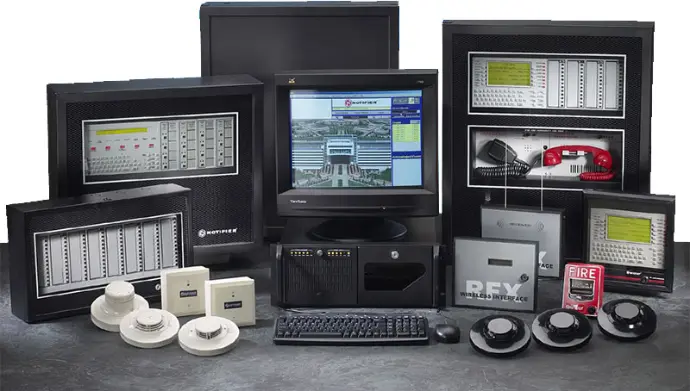
What a Fire Detection & Alarm System Does
- Detects fire signatures early (smoke/heat/flame) through sensors
- Triggers sounders, hooters, strobe lights, or voice evacuation (as designed)
- Displays alarm/fault status on the main panel (and repeater panels where required)
- Supports cause-and-effect actions like releasing magnetic door holders, controlling HVAC dampers, lift recall, fire pump interfacing, and BMS integration (as per project needs)
Benefits of Fire Detection & Alarm

Small Residential
- Early warning for sleeping occupants.
- Reduced risk of smoke inhalation and panic.
- Supports safe evacuation routes with sounders and visual alerts.

Government & Critical Infrastructure
- Designed for large footprints and multiple buildings
- Reliable event logging and structured response.
- Supports centralized monitoring and managed maintenance programs.

Mid to Large Corporate & Industrial
- Accurate device-level alarm display for fast action.
- Integration with access control, BMS, fire pumps, and emergency response workflows.
- Better maintenance visibility and auditing support.

Small Shops / Small Offices
- Business continuity: reduces asset loss and downtime.
- Quick alert to staff and visitors.
- Visible compliance and safety culture for customers.
Frequently asked questions
Smoke detectors respond early to smoke particles, while heat detectors respond to abnormal temperature rise—often used in kitchens, dusty areas, or locations where smoke detection may cause false alarms.
Yes. Fire alarm panels can interface with flow switches, valve supervision, fire pumps, and other safety systems through modules and programmed logic (as per design).
Typically addressable is preferred due to device-level identification, scalability, and faster troubleshooting in larger footprints.
Yes. ACE Technologies supports end-to-end lifecycle service—design, supply, installation, testing, commissioning, and AMC.
It depends on occupancy, ceiling height, airflow/HVAC, dust/steam conditions, and fire risk. We conduct a site survey and recommend the right combination.